Key Programs
- Key Programs
- Enhancing User Rights and Interests
Operation of the Telecommunications Complaint Mediation Center
The center provides consultation and mediation services related to telecommunications identity theft cases, enabling disputes between users and service providers to be resolved quickly and fairly.
Program Objective
To promote a sound telecommunications distribution market by operating the Telecommunications Complaint Mediation Center and handling related matters such as dispute mediation between telecommunications service providers and users through the Telecommunications Complaint Review Committee, as well as providing relief for identity theft damage.
Program Details
Provide counseling services related to telecommunications identity theft and illegal mobile phone loan incidents.
Conduct first-stage mediation for lines associated with identity theft cases based on the service provider’s responsibility and whether the account holder was involved.
If mediation between the telecommunications company and the applicant fails (mediation not accepted), a dispute review committee is convened to conduct a second-stage mediation and recommend a settlement.
- Processing Procedure : Submission of mediation application → Request for explanation from the relevant telecommunications company → Review of documents from both parties and first-stage mediation → If mediation fails → Second-stage mediation through a review committee meeting

Consultation Channels
Website: www.msafer.or.kr, Telephone: 080-3472-119
Mediation Process
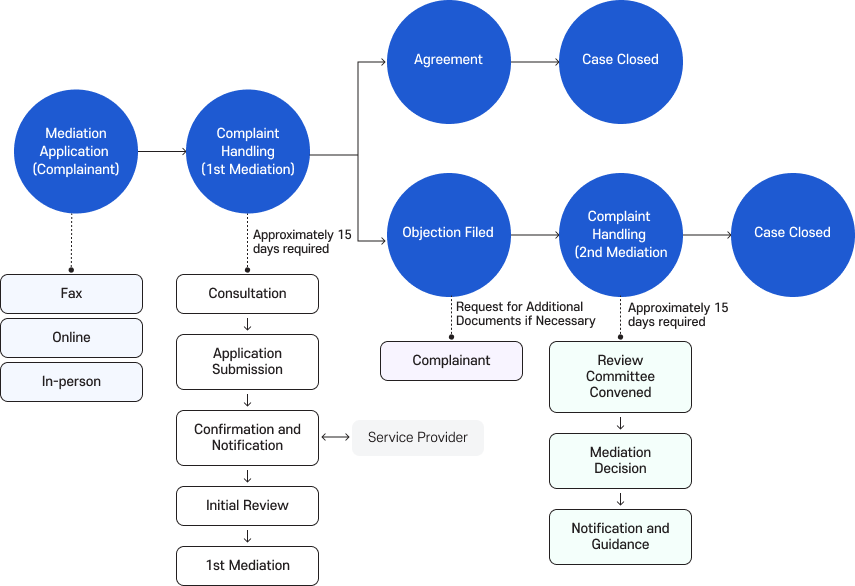
Mediation Application
- Accept complaints that have been rejected or returned by telecommunications service providers.
- ※ After reporting identity theft to the relevant service provider and confirming the receipt and results, the mediation application form may be submitted online (Msafer.co.kr) or by fax.
Mediation Method
- 1st Mediation: The center requests relevant materials from the service provider regarding the received complaint and verifies the facts, including the circumstances at the time of service activation, in order to prepare a first mediation proposal.
- 2nd Mediation: If the complainant or service provider raises an objection to the first mediation result, a review committee composed of experts in relevant fields re-examines the facts and prepares a second mediation proposal.
Mediation Period
The processing period for submitted complaints generally takes approximately 15 days for the first mediation and approximately 15 days for the committee decision.
Operation of the Mobile Telecommunications Unfair Practices Reporting Center
The reporting center operates to prevent unfair practices in mobile phone sales and subscriptions—such as excessive subsidies, forced subscription to specific plans or add-on services, and false or exaggerated advertising—thereby eliminating violations of the Mobile Device Distribution Act by retail outlets and preventing harm to users.
Program Objective
To receive and process complaints regarding illegal or improper practices through the reporting center website and the National Petition Portal (e-People), while carrying out related activities to prevent and eliminate such practices.
Program Details
Encourage the reporting of illegal activities under the Telecommunications Business Act within the mobile communications market—such as false or exaggerated advertising, refusal to allow subscription to selective contract discounts, failure to introduce or use ID scanners, and undisclosed side agreements—and accept complaints through multiple channels, including the reporting center and the National Petition Portal.

Reportable Cases
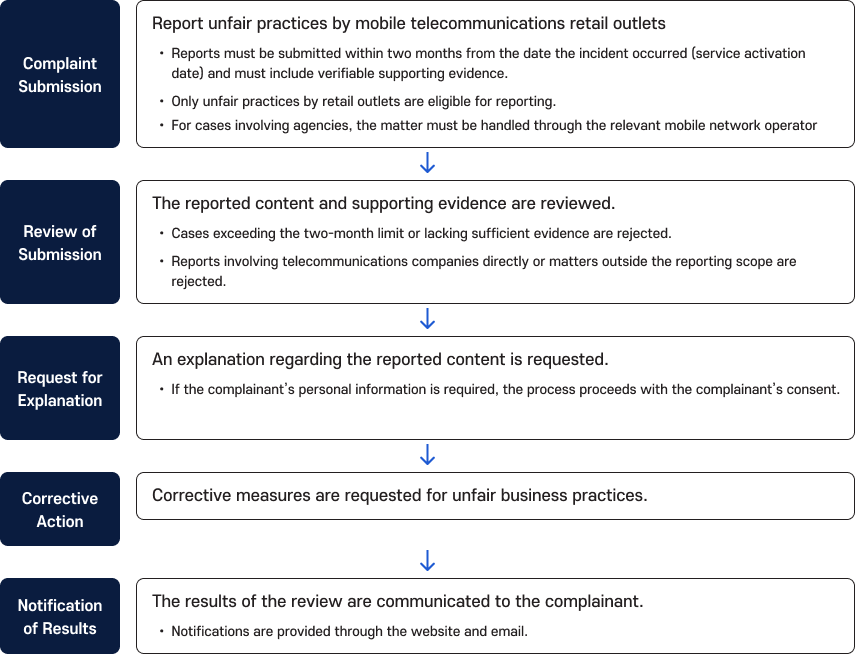
- Retail outlets engaging in unfair business practices such as false or exaggerated advertising or refusal to allow selective contract discount subscriptions(Excludes requests for compensation, investigations, or legal sanctions, and excludes reports related to fixed-line products.)
- ※ Cases involving unfair practices by agencies should be handled through the relevant mobile network operator.
- Reports may only be submitted within two months from the date the unfair practice occurred (activation date) and must include verifiable supporting evidence.
Scope of Reports
- Refusal to allow subscription to the selective contract discount program
- Advertisements that mislead users about the actual cost of purchasing a mobile device
- Advertisements that differ from reality or cannot be objectively verified
- Advertisements that omit important information
- Improper notification regarding device installment payments
- Sales activities by retailers without prior approval from the mobile network operator or failure to display the prior approval certificate
- Differential subsidy payments or inducement to subscribe to specific rate plans or value-added services
Processing Procedure
Operation of the Online Damage 365 Center
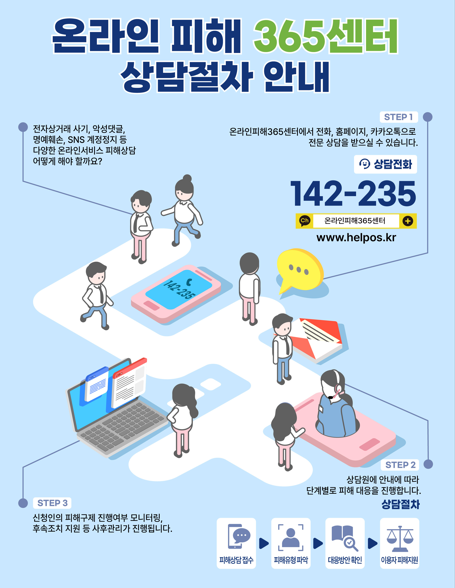
The center provides professional counseling services to help citizens respond quickly and systematically to various types of harm occurring online, including defamation, personal information violations, malicious comments, and cybercrime.
Program Objective
To support relief for victims by operating the Online Damage 365 Center and providing professional counseling services so that individuals can respond systematically to damage related to online services.
Overview of Responsibilities
- Provision of professional counseling services and support for victim relief so that users can respond quickly and effectively to various types of damage occurring online.
- Operation of:① Online Damage 365 Center Counseling Service (Call Center, ☎ 142-235)② Online Damage 365 Center Website (www.helpos.kr)③ Initiatives for online damage prevention, including the operation of a council of related organizations and public awareness activities.
※ Counseling center opened on May 31, 2022.
Program Details
Accept reports and provide consultation regarding online harm through telephone, website, KakaoTalk channel, and postal mail.
- How to Request Consultation
- ① Telephone: 142-235 (Nationwide toll-free representative number)
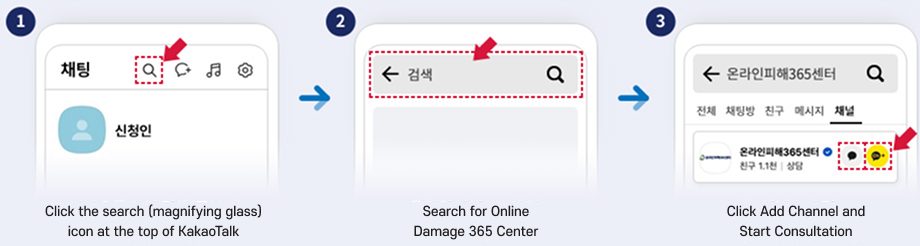
- ② KakaoTalk: Online Damage 365 Center (Add the KakaoTalk channel)
- ③ Website: Online Damage 365 Center (www.helpos.kr)
- ④ Mail: 2F, 135 Dogok-ro, Gangnam-gu, Seoul, Republic of Korea
[Reference] How to Add the KakaoTalk Channel
Operate specialized counseling personnel to provide professional consultation related to online service harm.
| Consultation Hours | ||
|---|---|---|
|
• Operates 5 days a week (Monday–Friday) ※ Consultation requests via KakaoTalk and the website are available year-round |
Telephone Consultation |
• 09:00~12:00, 13:00~18:00 |
|
KakaoTalk Consultation |
• (Request) 24 hours a day, 365 days a year / (Response) Same hours as telephone consultation |
|
|
Website Consultation |
• (Request) 24 hours a day, 365 days a year / (Response) Same hours as telephone consultation |
|
| Main Responsibilities of Counselors |
|---|
|
• Provide emotional support by listening to applicants describing online service-related damage • Provide guidance on submitting consultation requests, required documents, and relevant legal information • Provide information on relevant relief institutions and major procedures for resolving online service-related damage • Provide in-depth consultation and response guidance to support damage relief |
Consultation is provided for all types of damage related to online services, regardless of jurisdiction.
| Consultation Scope (Types of Damage) | |
|---|---|
| Type of Damage | Description |
| Goods and Services | Damage related to subscriptions, quality, after-sales service (A/S), and pricing of general consumer goods and tangible/intangible services (including C2C transactions) |
| Telecommunications | Damage related to subscription, charges, service quality, termination, and identity theft involving wired and wireless telecommunications services |
| Content | Damage related to subscription, pricing, quality, and advertising/labeling of video, games, knowledge information, apps, and other digital content |
| Rights Infringement | Privacy violations, intellectual property infringement, personal information violations, and user rights violations |
| Illegal or Harmful Content | Harmful information, prohibited content distribution, illegal advertising, illegal spam, etc. |
| Cyber Financial Crime, etc. | Network intrusion (hacking), information network crimes (phishing, smishing), cyber fraud, etc. |
| Digital Sexual Crimes | Illegal filming or distribution of explicit content, obscene acts, mediation of prostitution, etc. |
| Cyber Violence | Cyberbullying in schools, workplace cyber harassment or sexual harassment, etc. |
If the competent authority responsible for damage relief is clearly identified, the user is guided to the relevant institution (General Consultation). If the jurisdiction is complex or unclear, in-depth consultation is provided.
| Consultation Handling Categories | |
|---|---|
| General Consultation |
• Provided when the responsible authority for damage relief and the response measures are clear and singular. Guidance is provided based on the pre-established consultation manual, including contact information for the relevant institution and its procedures for handling the case. |
| In-depth Consultation |
• Provided when the responsible authority for damage relief is unclear, involves multiple institutions, or falls under the jurisdiction of the Korea Communications Commission. ① Professional Consultation: After verifying the relevant institutions and response procedures (consultation, reporting, damage relief, dispute mediation, legal support, etc.), guidance is provided to the victim. Support is offered in the form of a “1:1 damage relief assistant” to help ensure that the application and processing procedures proceed smoothly. ② Follow-up Management: Within several days after consultation is completed, the counselor contacts the applicant again to check the status of the response and provide additional guidance or alternative response measures if requested. |
| Other Consultation |
• Responding to inquiries regarding the damage consultation system and how to use the consultation center. |
Support for damage relief through guidance on responsible institutions and response measures

- Application for Online Service Damage Consultation
- -This is the stage where an applicant who has suffered damage while using online services submits a consultation request via telephone, mail, KakaoTalk, or other channels.
- Reception of Consultation Request and Identification of Damage Type
- -The counselor confirms details such as the date and time of the incident, location (URL or website name), and description of the damage. The damage type is then identified and categorized (general or in-depth).
- Confirmation of Responsible Institution and Response Measures
- -Based on the content and type of damage, the counselor reviews relevant laws, the responsible institution, and available damage relief methods.
- Guidance on Response Measures and User Support
- -If the responsible institution is clearly identified, the counselor provides information about that institution and the procedures for damage relief. If the jurisdiction is unclear or complex, in-depth consultation and response guidance are provided to support the user.
- Monitoring and Follow-up Management
- -• The counselor monitors the progress of the applicant’s damage relief process, checks for additional requests, and provides follow-up support as needed.
Promotional Materials