Key Programs
- Key Programs
- Enhancing User Rights and Interests
About Education on the Use of Telecommunications Services and Fraud Prevention
Education designed to help all telecommunications service users safely and effectively use services. It covers key precautions when subscribing to, using, and terminating telecommunications services; the latest cases and prevention and response methods for major types of telecommunications and telecom-financial fraud; and guidance on major AI and platform services.
Program Objective
To support all telecommunications service users in using services safely and effectively, thereby preventing damage to users and strengthening their capabilities.
Program Details
- Information on using telecommunications services, including precautions when subscribing to, using, and terminating services
- Major case examples of telecommunications service fraud and telecom-financial fraud, along with response measures
- Information on using AI services and preventing related risks
- Basic smartphone usage guidance and instructions for using platform services
- Education programs for vulnerable groups such as older adults, persons with disabilities, and farmers and fishers in cooperation with relevant partner organizations
- Outreach education that allows users to receive training free of charge at convenient times and locations
- Precautions when purchasing or terminating telecommunications services
- Information on preventing damage from mobile phone sales fraud and telecom-financial fraud
- Basic smartphone usage guidance and instructions for using kiosks
About the Broadcasting and Telecommunications User Information Portal
A portal that provides integrated information to help users of broadcasting and telecommunications services select and use services in a rational and appropriate way. It offers essential information related to subscription, use, and termination of various services such as mobile communications, broadband internet, and bundled products. In addition, it continuously provides examples of potential user risks that may occur when using digital services—such as voice phishing and smishing—along with response methods through webtoons and case examples. Educational materials tailored to different user groups are also distributed to help improve digital literacy among digitally vulnerable populations.
Program Objective
As broadcasting and telecommunications services have become key elements affecting quality of life—supporting knowledge acquisition, communication, cultural engagement, and social networking—this program aims to establish an integrated information portal specialized in broadcasting and telecommunications services.
Program Details
- Introduction to telecommunications services (mobile communications, broadband internet, telephone, TV, bundled products)
- Guidance on key information and precautions for each service stage (subscription, use, termination)
- Useful services such as checking unclaimed telecommunications refunds, verifying eligibility for selective contract discounts, and overseas roaming guidance
- Guidance on how to respond when problems arise with broadcasting and telecommunications services

- Information on telecommunications service misuse cases (false or exaggerated advertising, forced subscription to high-priced plans or add-on services, etc.)
- Information on financial fraud cases (voice phishing, smishing, webcam extortion scams, romance scams, pharming, messenger phishing, scams, etc.)
- Guidance on user protection channels such as the identity theft prevention service, the floating advertisement reporting center, and generative AI user participation platforms
- Provision of the latest case examples and smart webtoon content categorized by fraud type

- Educational content and materials tailored to different user groups (older adults, youth, persons with disabilities, multicultural families, etc.)
- Online courses on telecommunications service use and fraud prevention
- Outreach education programs on telecommunications services

- Information on key broadcasting and telecommunications policies and trends
- Provision of ICT statistical information

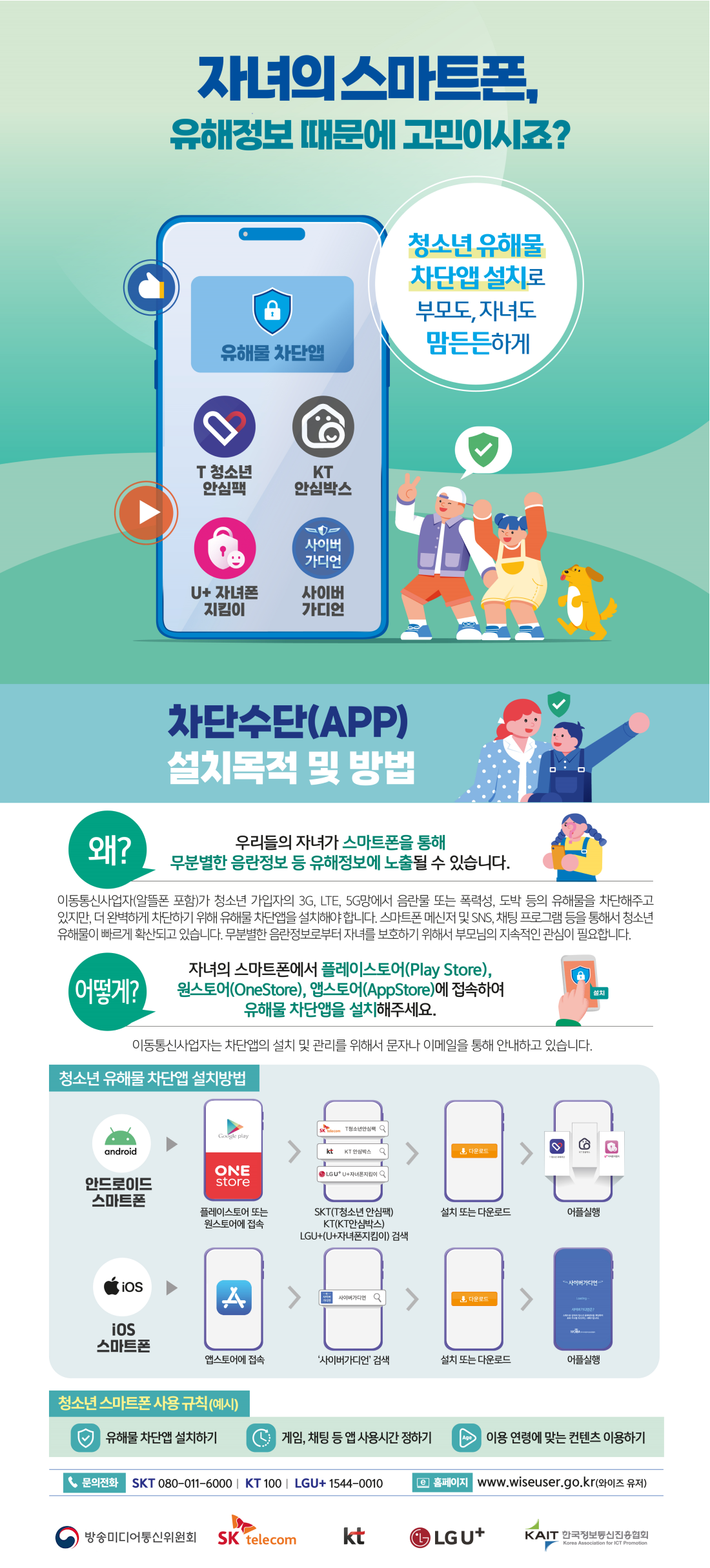
About the Guidance on the Provision of Youth Harmful Content Blocking Tools
A program that provides guidance and support regarding the obligation of mobile network operators to provide harmful content blocking tools for youth smartphone subscribers.
Program Objective
In accordance with Article 32-7 (Blocking of Media Harmful to Youth) of the Telecommunications Business Act, this program provides guidance, promotion, and support to ensure that mobile network operators offer harmful content blocking tools to youth smartphone subscribers.
Operational Basis
- Article 32-7(1) of the Telecommunications Business Act: When entering into a service contract with a youth subscriber, mobile network operators must provide blocking tools for media harmful to youth (Article 2(3) of the Juvenile Protection Act) and obscene information (Article 44-7(1) of the Act on Promotion of Information and Communications Network Utilization and Information Protection).
- Article 37-10 of the Enforcement Decree: Specifies the methods and procedures for providing blocking tools, including notifying users of the type and details of the blocking tool at the time of contract, confirming installation, and notifying the legal guardian if the tool is deleted or not functioning.
Program Details
A promotional initiative encouraging mobile network operators (including mobile virtual network operators) to provide and install blocking tools (apps or software) that prevent access to media harmful to youth and illegal obscene information for youth subscribers (under the age of 19) and their legal guardians.
Promotion of blocking app installation through websites, blogs, and social media channels.
Distribution of promotional leaflets at mobile network retail stores, placement of advertisements at bus stops and subway media pillars, and distribution of informational leaflets during visits to elementary and middle schools.
Promotional Materials