Key Programs
- Key Programs
- Strengthening AI·ICT Industry Competitiveness
About the AI Computing Demonstration Infrastructure Advancement Program
A program that enhances computing infrastructure based on domestically developed AI semiconductors and supports the demonstration and utilization of AI and data services, thereby promoting the expansion of AI adoption across industries.
Program Objective
To foster the AI semiconductor industry, a core foundation of the AI and data ecosystem, by building and utilizing computing infrastructure based on AI semiconductors developed with domestic technologies.
Program Details
Establish an AI semiconductor (NPU) demonstration infrastructure with a total capacity of 155 PF to support large-scale inference computing, ranging from AI to large-scale generative AI.
Develop and operate a cloud-based platform to support the operation of AI computing infrastructure and AI service demonstrations.
Demonstrate commercial AI services—including large language models—using the established AI computing demonstration infrastructure and software libraries (14 projects in total).
※ Provides testbed support for the use of NPUs in government-funded projects and initiatives such as World Best LLM (WBL).
- Program Vision and Goals

Build 155 PF of computing capacity using domestically developed AI semiconductor chips with cutting-edge technologies.

Develop and operate a cloud platform that ensures compatibility and efficiency to maximize the utilization of AI infrastructure.

Demonstrate AI application services to generate and expand service value through the utilization of AI semiconductors.
- Expected Outcomes

- Accelerated growth of the domestic AI semiconductor market화
- Reduced operating costs and total cost of ownership (TCO) through the adoption of cloud computing solutions
- Creation of new jobs driven by increased demand for IT professionals
- Improved productivity and efficiency through AI-based technologies

- Establishment and expansion of a self-sustaining AI ecosystem
- Acceleration of digital transformation across industries
- Formation of an advanced cloud service ecosystem
- Advancement of technology standardization and global competitiveness

- Broader access to IT resources, promoting the widespread adoption and utilization of AI technologies
- Realization of ESG values, including reduced carbon emissions
- Enhanced service reliability, including improvements in data security
- Application of AI technologies as tools for addressing social challenges
Promotional Materials
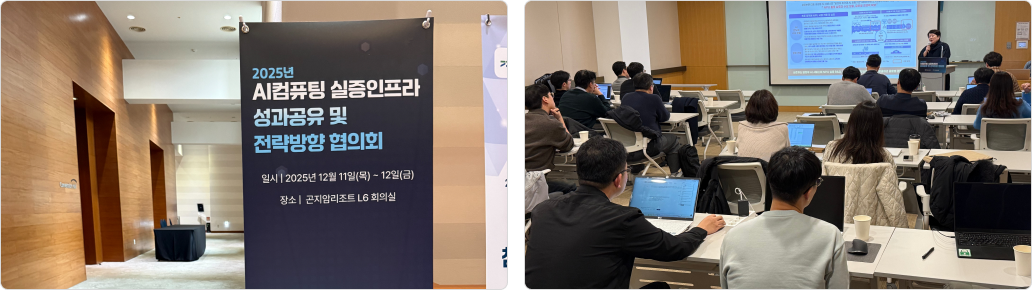
AI Computing Demonstration Infrastructure Achievement Sharing and Strategic Direction Council
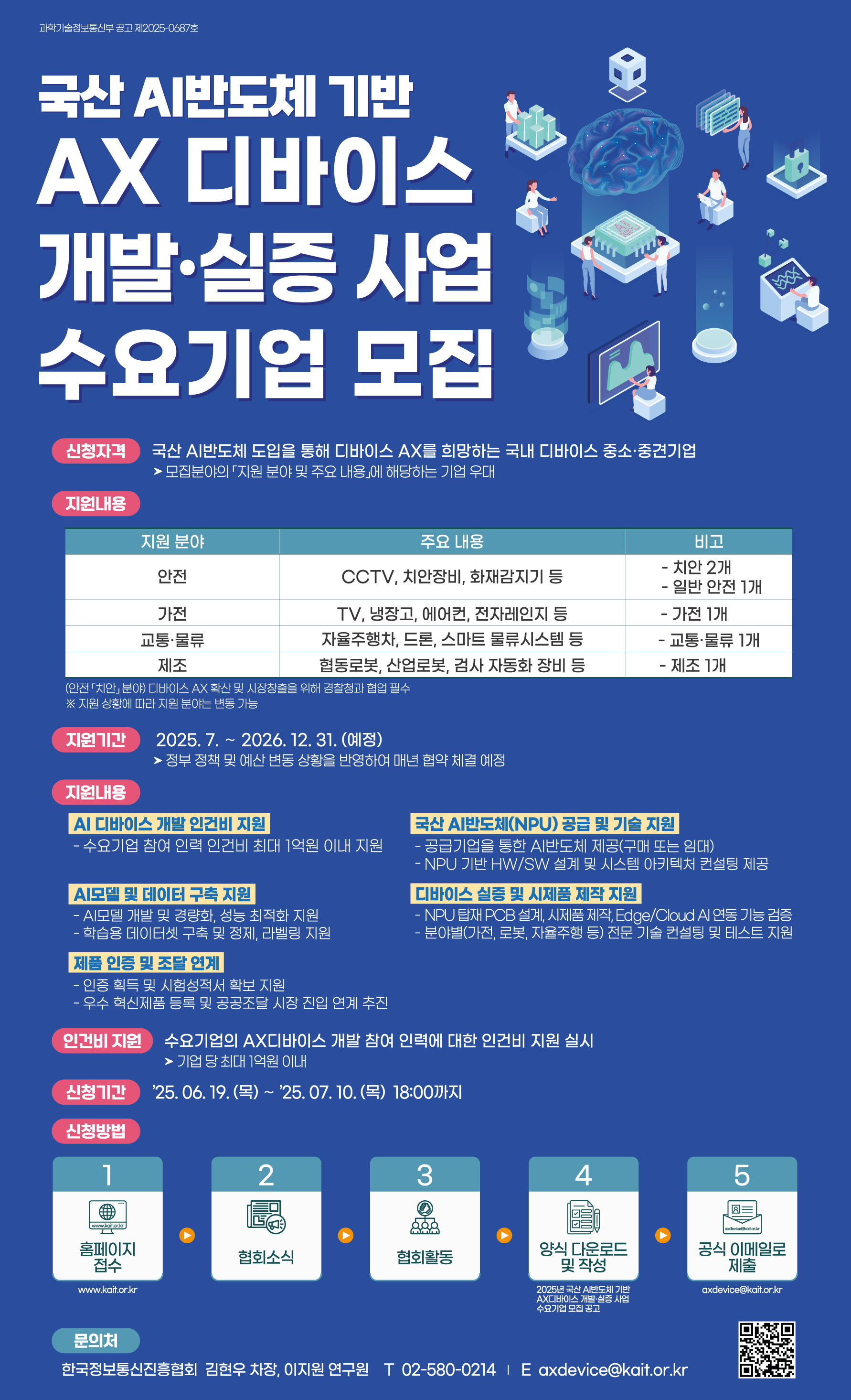
About the Development and Demonstration of AX Devices Based on Domestic AI Semiconductors
A program that supports the adoption and expansion of devices based on domestically developed AI semiconductors and promotes AX (AI transformation).
Program Objective
- By applying and validating domestic AI semiconductors (such as NPUs) in real devices, the program connects AI adoption—previously limited to the technology review stage—to product-level AX (AI transformation)
- Provide practical support for product advancement among small and medium-sized device manufacturers that are considering AI adoption or are currently in the PoC or demonstration stage
Program Details
Implementation Framework and Key Roles
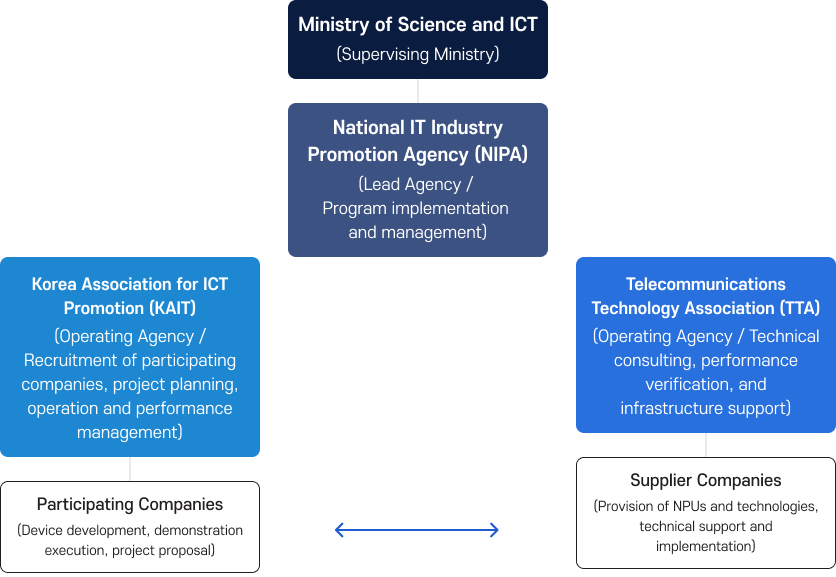
Companies are selected through a comprehensive evaluation of factors such as product characteristics, feasibility of demonstration, and future scalability.
Provides personnel cost support for research, development, design, and planning staff engaged by participating companies in the development of AX devices.
Provides demonstration-focused technical support, including AI semiconductor integration, performance verification, and technical consulting, along with related infrastructure support.
Promotes outstanding AX device demonstration cases through performance reporting sessions, casebooks, and promotional content.
- Details
| Structure | Scope | |
|---|---|---|
|
Ministry of Science and ICT |
• Management of project plans and budgets |
|
|
National IT Industry Promotion Agency (NIPA) |
• Project implementation and management |
|
|
Korea Association for ICT Promotion (KAIT) |
Recruitment and Selection Evaluation of Participating Companies |
• Promotion of the program targeting SMEs • Recruitment of participating companies • Conducting selection evaluations |
|
Support for Matching Between Participating and Supplier Companies |
• Securing supplier companies for each participating company • Matching by project field • Conducting document evaluations ※ Six projects by field (public safety/security, home appliances, transportation & logistics, manufacturing) |
|
|
Program Management |
• User surveys and performance assessments • Management of project report submissions • Organizing user training sessions, meetings, and performance reporting conferences • Producing a best-practice casebook • Settlement of resource leasing costs |
|
|
Telecommunications Technology Association (TTA) |
Program Implementation Management |
• Schedule management • Monthly project management for participating companies • Role management • Issue (risk) management |
|
Technical Support for AX Device Transformation |
• Technical consulting required for AI device development |
|
|
Infrastructure Utilization Support |
• Support for infrastructure utilization through TTA-owned/built infrastructure and cooperation with related institutions |
|
|
Reliability Verification |
• Performance verification of AI semiconductors • Support for AI model lightweighting and optimization • Demonstration and testing of AI semiconductors |
|
|
Participating Organizations |
• Proposal of projects and definition of requirements: defining product development objectives, required functions, and usage environments • Development of AX device prototypes in collaboration with supplier organizations • Cooperation in performance dissemination: sharing best-practice cases and supporting promotion of project outcomes |
|
|
Supplier Organizations |
• Provide technology and device AX support reflecting project requirements of specialized and participating organizations - Technology implementation and system development - Implementation of AI model and semiconductor-based functions - Prototype production and improvement |
|
Promotional Materials